This post is also available in:


Fuerteventura is one of the least populated and most open islands of the Canary archipelago. It is characterized by long beaches, gentle hills, wind, and very few towns. This combination gives the island its specific character, and for many travelers, this is the main reason to visit.
Fuerteventura thus offers an ideal combination of staying by the ocean, short trips inland, viewpoints, easy hiking trails, and local cuisine.

But there’s a catch. Distances between places are longer, public transport is limited, and if you try to see “everything,” you’ll spend most of your time in the car. However, once you understand where to stay, when to head north and when to go south, and where to find peace out of the wind, the island will show you its best.
And you’ll find everything you need in this practical guide to Fuerteventura.
Why visit Fuerteventura
Fuerteventura attracts visitors with endless beaches, ideal surfing conditions, and year-round warmth without extremes. It’s an ideal choice if you’re looking for peace, space, and an active stay by the ocean – whether you enjoy water sports, long walks, or just relaxing away from the crowds. Thanks to its safe beaches, it’s also suitable for families with children, while digital nomads will appreciate the infrastructure for both work and relaxation.
However, if you’re looking for nightlife or historical monuments, you’d be better off heading to one of the other Canary Islands.
How Fuerteventura “Works”: What You Should Know Before Planning
Fuerteventura is larger than it seems at first glance. Driving between the north and south of the island takes over an hour, and even though the island isn’t extremely vast, keep in mind that getting around isn’t fast.
While public transport is available, it mostly covers only the main roads and connects administrative centers, so if you want to move between different areas of the island, you’ll need a car.

One factor to consider when planning is the wind. It blows on Fuerteventura year-round. While the west coast is exposed to strong winds and waves, the north and east offer calmer bays and better swimming conditions.
Ocean weather can change quickly, so it’s good to have a plan A and B. Just in case.
The rhythm of the island is generally slower. Outside the main resorts, it’s common for lunch to shift into the afternoon hours and smaller businesses to have longer midday breaks.
Where to stay: how to choose the right base
Your choice of accommodation can fundamentally affect the pace and logistics of your entire trip. Instead of looking for the “best location,” it makes sense to choose based on the type of itinerary you’re planning: active movement around the island, peace by the beach, remote work, or traveling with children.
Corralejo (North of the island)
Corralejo makes sense if you want to combine beaches, local trips, and the amenities of a small town. Restaurants, cafes, shops, and the harbor are all within walking distance. In the north of the island, you have good access to the dunes, calmer sheltered beaches, and Lobos Island.
- Hotel Boutique Tao Caleta Mar – a smaller boutique hotel near the beach, a good choice for couples or a quieter stay; you can also reach the center on foot.
- Apartamentos Playa Park – practical apartments with a pool, also suitable for families; good value for money and easy access to the dunes and town.
- H10 Ocean Suites – a comfortable resort with pools and restaurants, suitable for those who want facilities while staying within walking distance of the center.
El Cotillo (Northwest)
El Cotillo is a quieter alternative. It offers a combination of open beaches and protected lagoons suitable for swimming. Compared to Corralejo, there are fewer services, but it’s excellent for longer stays when you don’t want to plan a new itinerary every day.
- Cotillo Ocean View – modern apartments with ocean views, ideal for a longer stay and a peaceful pace.
- Hotel Rural El Cabo – a smaller hotel with a more personal atmosphere, suitable for couples; close to lagoons and restaurants.
- Casa Colm El Cotillo – simple but well-maintained apartments in the center.
Caleta de Fuste (East of the island, near the airport)
If you’re traveling with children, Caleta de Fuste is one of the best options. The airport is a short drive away, and there are plenty of apartment resorts, shops, and beaches with a gradual entry into the water.
Don’t expect an authentic atmosphere here; it’s an area full of resorts. However, for a relaxed stay with children or a shorter holiday without a car, it’s a fairly suitable base.
- Barceló Fuerteventura Castillo – a seaside resort with apartments, pools, and animation programs; very suitable for families with children.
- Elba Carlota Beach & Golf Resort – a comfortable hotel by a protected beach, good facilities, and a short transfer from the airport.
- Elba Castillo San Jorge & Antigua Suite Hotel – a larger apartment resort with several pools and good access to the beach and airport.
Costa Calma and Morro Jable (South of the island)
The south makes sense for travelers who want to spend more time on the beach and less time moving around. At the same time, you have to expect longer drives to the northern part of the island.
- INNSiDE by Meliá Fuerteventura (Costa Calma) – a modern hotel by Sotavento beach, ideal for a quieter stay, yoga, and being by the ocean.
- Hotel Riu Palace Jandía (Morro Jable) – a luxury hotel right on a long beach.
- Occidental Jandía Playa – a reasonable compromise between price and service, a good base for beaches and trips to the south of the island.
One or two bases?
For stays longer than a week, it often pays off to split your accommodation between the north and south. This allows you to shorten daily drives and better respond to ocean conditions. You can then combine the move between bases with a visit to the interior.
If you prefer one place or don’t want to deal with packing, a base in the north or east of the island makes the most sense, as you can easily get to most “essential” spots from there.
What to see and visit
Corralejo Natural Park
The dunes at Corralejo are one of the island’s most striking natural phenomena, where sand, ocean, and wind meet. A walk along the edges of the dunes or along the coast offers magnificent views, where on one side you’ll see the turquoise sea and on the other volcanic hills.

The walk takes one to two hours, but you can easily spend the whole day here. Ideally, combine it with a swim at the nearby beaches. The best access is by car (parking by the FV-1 road), or by bus from Corralejo. Don’t forget sunscreen and plenty of water – you won’t find any shade in this area.
Isla de Lobos
Isla de Lobos is a small, uninhabited island just off the north coast of Fuerteventura and is one of the best tips for a day trip. It attracts visitors mainly with its preserved nature, quiet beaches, and simple hiking trails that lead through volcanic landscapes and along the coast.
You’ll find several easy loops around small bays and viewpoints, as well as spots suitable for snorkeling. The water is usually very clear, and thanks to the rich underwater life, it’s one of the best places on the island to look below the surface without needing diving equipment.

The boat from Corralejo harbor to Isla de Lobos runs several times a day, and the crossing takes only about 15 minutes. Be prepared, though, that it can get quite bumpy in places.
Before traveling to the island, it is necessary to have a permit, which is free and can be arranged online. You’ll find almost no facilities on the island, so don’t forget to bring food, water, and a hat.
Czech Travellers Tip: The only restaurant on the island is often full, so we recommend booking in advance. However, you can stop by “just” for a coffee or ice cream.
Playa de Sotavento
Playa de Sotavento is one of Fuerteventura’s most famous beaches and regularly appears in lists of the most beautiful places in the Canary Islands. More than five kilometers of fine golden sand stretch along the southeast coast, and the characteristic feature here is the lagoons that form at high tide.
At high water, the sea spills into shallow lagoons separated by sandbars – creating calm areas suitable for photography, wading, or paddleboarding. At low tide, a wide open beach is revealed, ideal for long walks. Thanks to the steady wind, the area is popular with kitesurfers and windsurfers; in the right conditions, the shallows are also suitable for beginners.
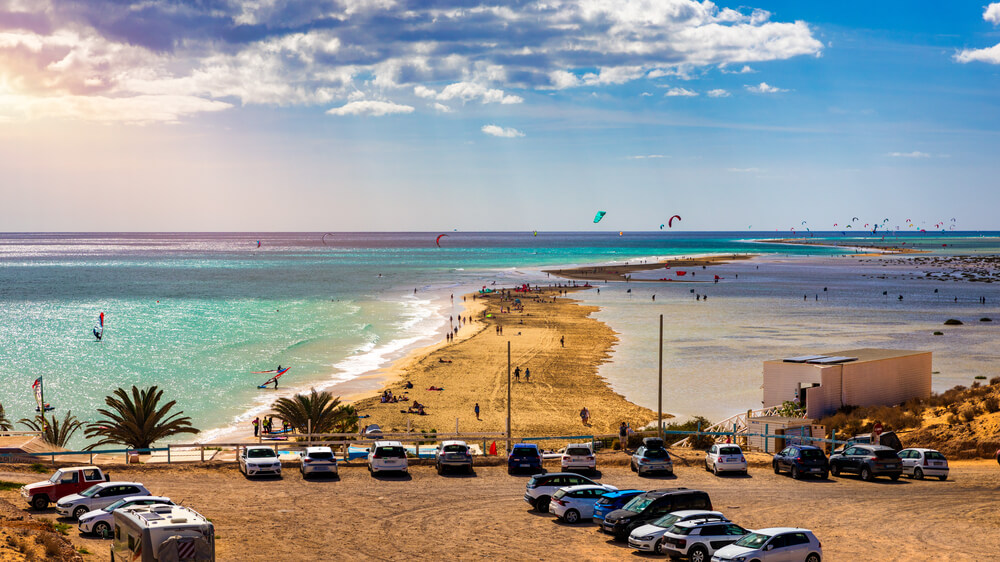
The beach is located near the resort of Costa Calma and is easily accessible by car – there are free parking lots at several entrances. There are no extensive services on the beach, so bring water, food, and sun protection.
Czech Travellers Tip: Since the beach’s appearance changes significantly with the tide, it’s worth checking tide times before your visit.
Betancuria
Betancuria is the historical heart of Fuerteventura and the island’s former capital. This picturesque village, nestled among green hills, is known for its traditional white architecture, narrow streets, and peaceful atmosphere that transports you back in time.

Betancuria is an ideal destination for history and culture lovers. You can visit the Archaeological Museum, which introduces you to the island’s history, and the Santa María Church, considered one of the oldest on Fuerteventura. There are also several hiking trails around the village leading to viewpoints from which you can see even the lesser-known parts of the island.
Betancuria is located in the central part of Fuerteventura and is easily reached by car. Parking is also usually hassle-free here.
Ajuy and the black beaches
Ajuy is a small fishing village on the west coast of Fuerteventura, known not only for its black sand beach but also for the caves and cliffs nearby. An easy coastal path leads from the village to the caves. The path can be slippery in places, so don’t underestimate the need for proper footwear.
Czech Travellers Tip: Check the tide times before visiting – at low tide, the caves are more accessible and you can safely view them up close.
You can also refresh yourself in the sea at the beach in Ajuy. The water is usually clean but colder than at other beaches.

Parking is free, as is access to the beach. And around the village, you’ll find several restaurants where you can enjoy fresh fish and seafood.
Mirador Morro Velosa
The Mirador Morro Velosa viewpoint is one of the best places to get a sense of Fuerteventura’s interior – the open volcanic landscape, rolling hills, and deep valleys feel even more striking here than from road level.

The design is by Canarian architect César Manrique, who long advocated for the sensitive integration of buildings into the landscape (his signature is most prominent on Lanzarote). The viewpoint building itself is currently closed for renovation, but the panoramic views from the surrounding area remain accessible.
The Mirador is located between Betancuria and Valle de Santa Inés and is easily reached by car via a mountain road.
Czech Travellers Tip: It’s almost always windy at the top and the temperature is lower than on the coast – even in summer, a light hoodie or windbreaker is worth having.
El Cotillo and La Concha Beach
El Cotillo is located on the west coast and acts as a quieter counterpoint to the busier Corralejo. The former fishing village has retained its relaxed atmosphere and is best known for the system of natural lagoons north of the center.
The most famous of these, Playa de La Concha, offers fine light sand and a gradual entry into the water. Thanks to protective rock formations, the ocean here tends to be calmer than in other parts of the west coast, making it a suitable spot for families with children.

You can get to El Cotillo by car or bus from Corralejo or Puerto del Rosario. There are several free parking lots near the beaches, and in the village itself, you’ll find plenty of restaurants and cafes – especially around the old harbor. The lagoons are also suitable for snorkeling, but keep in mind that conditions change with the wind and tide.
Oasis Wildlife Fuerteventura
Oasis Wildlife near the village of La Lajita is one of the largest zoos in the Canary Islands and is one of the main family attractions in the south of Fuerteventura. On the extensive grounds, you’ll find more than 250 species of animals, a botanical garden with a large collection of cacti and succulents, and rescue programs focused on endangered species. The site also includes a farm with domestic animals, which is particularly popular with younger children.

Keep in mind that the grounds are really large and you’ll walk several kilometers during your visit – on the other hand, it’s clearly signposted and offers plenty of shade, benches, and refreshments. The animals have spacious enclosures and often multiple viewing points, making observation and photography easier.
Admission is around €35 for an adult, with a reduced price for children. We recommend booking online in advance. You can buy food for selected animals on-site; the biggest draw is usually feeding the giraffes, which has limited capacity, so it’s worth heading there right after you arrive.
Punta Jandía Lighthouse
The Punta Jandía Lighthouse is an iconic symbol of the southernmost point of Fuerteventura, where the wild Atlantic meets the volcanic landscape. Built in 1864, it is one of the oldest lighthouses in the Canary Islands and still serves its purpose today. It offers fascinating views of the wide ocean and the surrounding inhospitable cliffs, which are part of a natural park.

The lighthouse can only be reached by car via an unpaved gravel road leading from Morro Jable or Costa Calma. The last section is passable with a regular car, but you need to drive carefully as the road is quite narrow and winding.
Czech Travellers Tip: The lighthouse itself is not accessible, so if you’re not planning a stop in the area (for example, Cofete), it might be an unnecessarily long detour.
Cofete
Playa de Cofete is one of the wildest and most impressive places on Fuerteventura. The more than 12-kilometer-long beach lies beneath the Jandía massif and feels almost like the end of the world. It’s the combination of vastness, mountains at your back, the powerful Atlantic, and minimal development that makes Cofete one of the most authentic beaches on the island.

The route here is the same as to the Punta Jandía lighthouse – from Morro Jable you get here after more than 20 km of unpaved road. There is no infrastructure on the beach – no bars, showers, or shops – so bring plenty of water, food, and sun protection. The waves are powerful and the currents strong, so swimming is not always advisable.
What else to see
Beaches and Coastline
- Playa de Esquinzo (La Oliva) – a remote beach in the northwest of the island with no facilities, ideal for walks and very few people.
- Piscinas Naturales Aguas Verdes – natural rock pools on the west coast, interesting mainly when the sea is calm; water shoes are recommended.
- Majanicho – an almost deserted fishing settlement and surfing spot.
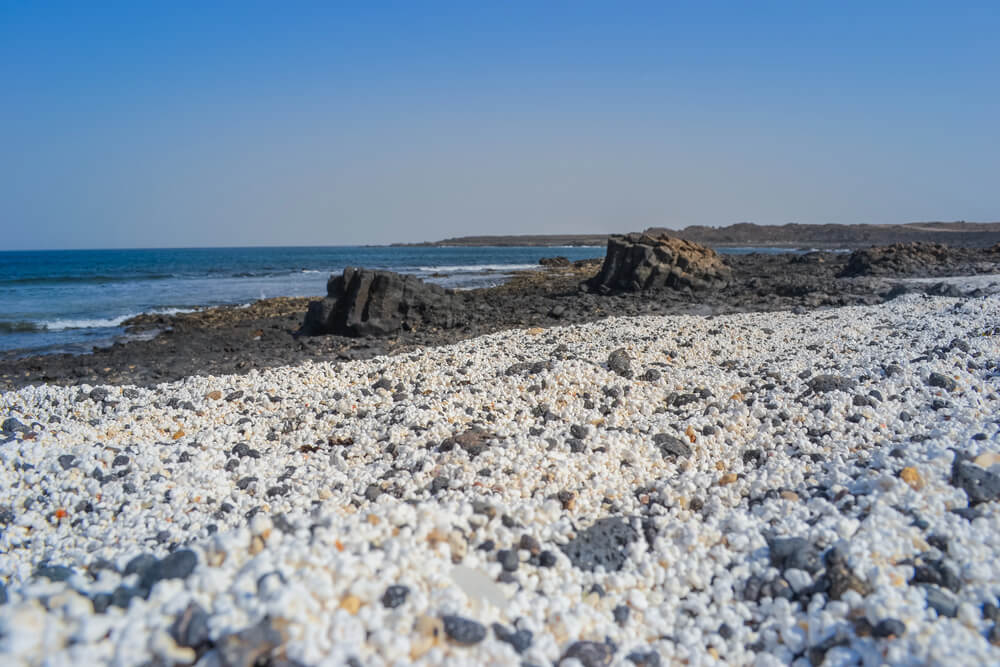
- Popcorn Beach – an unusual beach near Corralejo with a “grainy” surface made of rhodoliths (calcified algae) that resembles popcorn; not suitable for swimming.

Nature, Mountains, and Hiking
- Bayuyo Volcano – one of the most accessible volcanic cones in the north of the island; a short hike with views of Corralejo and the ocean.
- Cuchillos de Vigán – a mountainous area with rocky ridges and views; suitable for peaceful hiking trails away from the main crowds.
- Las Peñitas – a beautiful gorge near Betancuria; an easy hike with a dam and rocks.
Towns and Villages
- Gran Tarajal – an authentic town with a dark beach, restaurants, and very few tourists; a good stop for lunch and a swim.
- Puerto del Rosario – the island’s capital; not very touristy, but good for shopping, street art, and a short stop.
- Tefía – an inconspicuous inland village, a good starting point for Ecomuseo La Alcogida and quiet trails outside tourist areas.

History, Culture, and Tradition
- Montaña de Tindaya – a sacred mountain of the indigenous people; you don’t climb to the top, but the surrounding trails offer nice views.
- Ecomuseo La Alcogida – a small but very informative open-air museum of traditional island life, also suitable for children.
- Museo de la Sal (Salinas del Carmen) – a very well-done salt museum at working salt pans, a good short stop when moving along the east coast.
- Museo del Queso Majorero (Antigua) – a museum dedicated to local goat cheese, with the possibility of tasting and buying.
- Los Molinos – a small village on the west coast, known mainly for its traditional gofio (toasted grain) museum in a historic mill.

What to experience?
Dolphin and Whale Watching
From the harbors in Morro Jable and Corralejo, boats depart for several-hour trips into the open ocean. Dolphins are seen quite often; for larger whale species, it depends on the season and luck. Expeditions are usually conducted with respect for nature, often in smaller groups.
Keep in mind that the ocean can get quite wavy – motion sickness medication is useful for sensitive travelers.
Surfing or Kitesurfing
Fuerteventura is one of the best places in Europe for surfing and kitesurfing. In the north of the island at Corralejo and El Cotillo, there are stronger waves suitable for advanced surfers, while Playa de Sotavento in the south is ideal for beginners thanks to its shallow lagoon and stable wind.
Surf and kite schools operate year-round, courses can be arranged even at the last minute, and equipment is usually included in the price.

Evening Tapas Tour with Locals
In larger towns, such as Puerto del Rosario or Corralejo, organized tapas walks are held. During the evening, you’ll visit several establishments, tasting small portions of local food and wine in each, and gain an overview of Canarian cuisine and everyday island life.
If you prefer your own pace, you can “do it yourself” – just visit a few bars in the center and stick to where the locals are sitting.
Night Stargazing
Thanks to minimal light pollution, the island is one of the best places for observing the night sky. Just head outside the resorts, ideally into the interior or to viewpoints in the mountains.
Organized stargazing takes place, for example, around Tefía, or you can take a blanket and a thermos and go on your own. Clear, moonless nights offer a view of the Milky Way that you’ll rarely experience in continental Europe.
Cheese Making or Other Craft Workshops
Fuerteventura is known for Majorero goat cheese, and in some villages or farms, short cheese-making workshops, tastings, or art workshops inspired by the local landscape can be arranged. The programs are usually intimate, led by locals, and also suitable for families. You’ll take away not only a new experience but often a small souvenir with a clear origin.
What to do with children?
Fuerteventura is a great choice for a holiday with children – and not just because of the endless beaches with gradual entry into the water. Little travelers will enjoy a day at Oasis Wildlife Park, where besides animals, camel rides or interactive shows await.
At Playa La Concha in El Cotillo, children can play safely in shallow water protected by reefs, and if you’re looking for something unusual, head out on a boat snorkeling trip to Lobos Island – swimming in crystal-clear water is an experience even for younger children.
Older kids will love the surf schools for beginners, which have courses for children from 6 years old. And if you just want to relax, the sand dunes at Corralejo are ideal, where children can run to their heart’s content and enjoy the simple joy of being in nature.
How to get to Fuerteventura
By Plane
Getting to Fuerteventura from continental Europe or the UK is not difficult, and thanks to direct flights and affordable ticket prices, this island has become a popular choice for a winter escape or summer holiday. The fastest and most convenient option is, of course, by plane – both direct and connecting flights are available throughout the year.

Carriers like Ryanair, EasyJet, Iberia, Lufthansa, Vueling, or Eurowings offer connections throughout the year, and with early booking, you can often get a very reasonable price.
Fuerteventura Airport (FUE) is located just a few kilometers from the capital Puerto del Rosario and most resorts.
After arrival, you can easily get further – either rent a car directly at the airport (we recommend booking in advance) or use bus line no. 3, which connects the airport with the center and the resorts of Caleta de Fuste and Las Salinas. Alternatively, you can take a taxi, which pays off when sharing with other travelers.
By Boat
If you plan to explore other Canary Islands, it makes sense to use boat connections. Fuerteventura has excellent ferry connections to neighboring Lanzarote – from Playa Blanca harbor (Lanzarote), boats run several times a day to Corralejo in the north of Fuerteventura.
The crossing takes less than half an hour and is operated by companies like Fred Olsen Express, Naviera Armas, or Lineas Romero. You can also bring a rented car, or rent a new one after arriving on the island.
Even from other Canary Islands – for example, from Gran Canaria or Tenerife – you can get here within a few hours. This is more of an option for travelers who are taking their time and want to explore multiple islands as part of one longer stay.
Czech Travellers Tip: If you want to approach the trip as a larger exploration, a great option is to fly to Lanzarote, drive around it by car, and then move to Fuerteventura by ferry. Flights to Lanzarote tend to be more frequent and cheaper.
Food and Places: What to Taste and Where to Go
Outside the resorts, you’ll find smaller restaurants with daily specials, while in the resorts, there’s a wide range of establishments oriented mainly toward tourists. Opening hours and days of operation can change according to the season; for smaller businesses, it’s always advisable to check them.
What is typical for Fuerteventura
Local cuisine is simple, built on quality ingredients and short preparation without complex combinations. The basis is fresh fish and seafood – daily catches like vieja (parrotfish), sardines, or tuna are often served. A good sign is a short chalkboard with the current offer based on what was actually caught.
Czech Travellers Tip: If a restaurant offers only a general, long menu without daily specials, it’s usually targeting tourist traffic rather than freshness.
A typical side dish is papas arrugadas – small potatoes boiled in very salty water, served with mojo rojo (red, slightly spicy) or mojo verde (made from cilantro or parsley) sauces. Another symbol of the island is queso majorero, a local goat cheese with a protected designation of origin. In restaurants, you’ll get it as an appetizer, often with honey or jam; it’s worth trying different stages of aging.
A traditional ingredient is also gofio, toasted flour made from wheat or corn, which is used in soups, desserts, or as a side dish. Today you’ll encounter it mainly in more traditional establishments and outside the main resort areas.

Daily Dining and Breakfast
In smaller villages and outside main tourist centers, it’s worth looking for restaurants with a lunch menú del día. They offer good value for money, fast service, and are ideal on days when you have a trip or travel across the island planned.
For simple lunches, bakeries, small tapas bars, or supermarkets also work well – a combination of bread, local goat cheese, and fruit is quite practical for on-the-go.
In larger resorts, especially in the north of the island, a more modern cafe scene is gradually developing. If you’re looking for a quiet place for breakfast or need to work remotely, focus on establishments with specialty coffee and a simple brunch menu. Outside the main season, however, expect more limited opening hours – smaller cafes may be closed several days a week or only operate in the morning.
- Baobab Juice Bar (Corralejo) – A popular breakfast cafe with specialty coffee, smoothie bowls, and a light brunch menu. A good place for a slow morning or remote work.
- El Goloso de Cotillo (El Cotillo) – A pleasant stop for breakfast or afternoon coffee, offering sweet and savory pastries and seating near the ocean.
Dinner and Gastronomic Experience
Even on Fuerteventura, you’ll find several smaller restaurants that work with local ingredients in a more modern way, offering thoughtful tasting menus or seasonal offers based on current catches and harvests. These are often intimate establishments with limited capacity, where booking in advance is almost a necessity – especially on weekends or in high season.
If you’re planning a “nicer dinner,” schedule it for a quieter day without long drives. Dinner here tends to be an experience lasting several hours rather than a quick stop after the beach – and that’s exactly where its charm lies.
- La Jaira de Demian (Puerto del Rosario) – Creative modern Canarian cuisine with a seasonal menu and emphasis on local ingredients. One of the best-rated restaurants on the island; a reservation is almost a necessity.
- Casa Santa María (Betancuria) – An interesting establishment in a historical setting that combines traditional Canarian recipes with a more modern approach. An ideal stop during a trip inland.
- Avenida Restaurante (Morro Jable) – Precisely prepared fish and Mediterranean cuisine with ocean views. Suitable for a quiet dinner in the south of the island; reservations are recommended.
Practical information
Getting Around the Island: Car vs. Bus vs. Taxi
For systematic exploration of the island, a car is the most practical choice. It allows you to respond flexibly to the wind, choose beaches out of the wind, and combine multiple places in one day without tedious transfers.
Without a car, it’s possible to operate within one area (Corralejo, Caleta de Fuste, Morro Jable) and take individual trips by bus, but your itinerary must be more closely adapted to the schedules.
Taxis are worth it for shorter trips within resorts and to/from the airport. For longer distances, however, they are unnecessarily expensive and, moreover, hard to find in less populated parts of the island.

Roads on Fuerteventura are clear and main routes are in good condition. The challenge is more the wind, open terrain, and some gravel access roads to beaches. If you rent a regular passenger car, it’s sensible to stick to paved roads and walk to more remote beaches from the last safe parking spot.
Parking in towns and resorts is usually easy; in busy beach areas, it pays to arrive earlier in the day.
Public Transport in Detail
Public transport on Fuerteventura is provided by the company Tiadhe and consists exclusively of buses (guaguas). The network is designed mainly to connect larger towns, resorts, and administrative centers – typically Corralejo, Puerto del Rosario, Caleta de Fuste, Gran Tarajal, Morro Jable, or Costa Calma.
If you plan to move between these places, the bus is a usable and affordable option. However, as soon as you head to smaller villages, more remote beaches, or the interior, connections quickly thin out or disappear completely.

The island’s main transfer hub is Puerto del Rosario, where most lines intersect. In practice, this means that even a relatively short route may require a transfer and more time. The frequency of services is low outside main routes – typically 3–6 services per day per line, often fewer on weekends. Therefore, it’s necessary to plan ahead and not rely on “random” trips.
Schedules and line maps can be found on the carrier’s official website: tiadhe.com (English and Spanish versions). We recommend always checking connections just before your trip – schedules change according to the season and some lines only run on weekdays.
Payment is made directly to the driver, usually in cash (small change is practical, cards are not accepted everywhere). The price depends on the distance:
- short trips between towns usually €1.40–€2.50
- longer routes (e.g., Corralejo – Morro Jable) roughly €8–€10
There are also multi-day or prepaid cards (bonos), but these are more worthwhile for daily commuting.
Money and Prices
Fuerteventura is price-comparable to the other Canary Islands and, with reasonable planning, is one of the more affordable destinations in Western Europe. In a regular cafe, you’ll pay approximately €1.50–€2.50 for an espresso or café con leche; a cafe-style breakfast usually ranges around €6–€10.
A lunch menú del día in local restaurants usually costs €10–€15 and often includes an appetizer, main course, drink, and sometimes dessert. Dinner in a higher-quality restaurant typically ranges between €20–€30 per person, and can be higher in tourist areas and by the ocean.

Accommodation prices fluctuate significantly according to season, location, and type of housing. Apartments outside main resorts can be found from €60–€80 per night outside the winter peak, while resorts in the south of the island or by the beach tend to range from €120 up in high season.
The north of the island, El Cotillo, or the inland areas tend to be more affordable in the long run than Costa Calma or Morro Jable. Renting a car costs approximately €25–40 per day when booked in advance; fuel is cheaper in the Canary Islands than on the mainland (often around €1.30–1.50 per liter).
Card payments are common in most restaurants, supermarkets, and gas stations. However, in smaller villages, local bars, or when paying on the bus, it’s useful to have cash, ideally smaller bills.
We never head abroad without valid travel insurance and a Revolut card.
Tipping isn’t mandatory, but rounding up or leaving a few extra euros in a restaurant is appreciated. Overall, by combining simple lunches, apartment stays, and a rental car, you can manage Fuerteventura very reasonably, even for a longer stay.
Internet, SIM/eSIM, and signal
In larger resorts (Corralejo, Caleta de Fuste, Morro Jable), mobile signal and data work without issues, as does Wi-Fi in most accommodations and cafes. Expect weaker coverage inland, on the west coast, or in the mountains around Cofete.
If you’re planning trips to more remote parts of the island, download offline maps. For longer stays or remote work, it’s better to check the connection speed directly with your specific accommodation beforehand—quality can vary.
If you’re from the EU, your regular domestic plan will work. For visitors from outside the EU, we recommend getting an eSIM data plan through Revolut.
Weather and when to go
Fuerteventura has a dry and stable climate year-round. Temperatures are mild, but the wind significantly affects how it feels. Summer is ideal for beaches and water sports, while winter is great for a mix of ocean time and excursions without extreme heat. When planning your day, keep an eye on the wind and wave forecast rather than just the temperature—ocean conditions can change quickly.
Safety and what to watch out for
The biggest risk is the ocean. Strong currents and high waves are common, especially on the open beaches of the west coast. Respect the signs and don’t enter the water where swimming is prohibited. Expect very little shade inland—plenty of water, a hat, and sun protection are essential. If you’re heading to remote areas, let someone know your planned route.