The Camino de Santiago attracts thousands of pilgrims every year who set out on foot to the Spanish city of Santiago de Compostela. However, such a pilgrimage requires proper preparation, and that’s exactly what this article will help you with. What to expect and what to pack?
What is the Camino de Santiago?
The Camino de Santiago, or the Way of St. James, is a pilgrimage route over 1,000 years old that leads pilgrims to the tomb of Saint James in Galicia, Spain. Several routes from various European countries, including the Czech Republic, converge here, but most people only walk the Spanish (or Portuguese) section. In 2021, nearly 179,000 people completed it.

To be officially counted among the pilgrims, you must walk at least the last 100 km (cyclists 200 km). Many Christians still undertake the Camino de Santiago primarily for religious reasons, but with its growing popularity, people of various religions and motivations are setting out on the journey. Since 1993, the Camino de Santiago has been on the UNESCO World Heritage list.
1. When to go on the Camino?
Since it is a spiritual journey, it doesn’t really matter, when you set off. A significant part of any pilgrimage (the Camino de Santiago being no exception) is getting to know yourself better.
Some find answers to their life’s struggles during a few days on the road, others come up with a new business, and some find gratitude for their way of life.

You will meet the most pilgrims on the Camino de Santiago during the summer holidays. If you dream of a solitary pilgrimage full of contemplation and without roasting in the sun, consider a different date.
You can travel to Santiago throughout the year, just keep in mind that some pilgrim hostels are closed during the winter. In winter, you can also expect more variable and colder weather, so your backpack will get a bit heavier with a few pieces of spare and warm clothing.
The ideal periods for the Camino de Santiago seem to be May and June, September and October. You’ll catch pleasant weather, and in the spring, everything will be beautifully in bloom around you. You’ll meet enough people on the way to join someone (if you want), but at the same time, you won’t feel like you’re on a highway.
2. Which route should you choose?
Several paths lead to Santiago, and it’s up to you which one you choose and how long a section you walk. If you have the desire, time, and good legs, just pack up, slam the door, and walk to Santiago from your own doorstep.
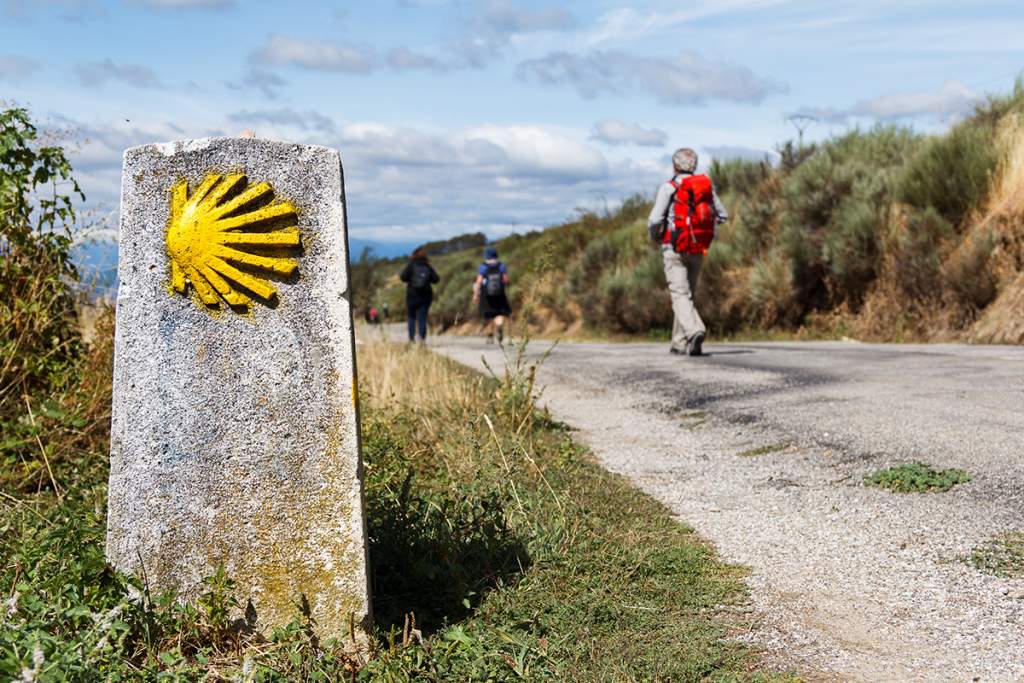
Have you noticed the scallop shell symbol alongside classic tourist signs during your trips around France or Spain (but also Slovakia, Germany, Switzerland, Czechia)? If you were to follow these Camino de Santiago markings further and further, they would lead you all the way to Santiago.

Most people choose a section of one of the Spanish routes. The most crowded is usually the so-called French Way. However, you can also set out for Santiago from the Mediterranean Sea, follow the coast of northern Spain, or walk a substantial part of the way through Portugal.

The most common routes to Santiago de Compostela:
- The French Way (Camino Francés) is the most popular and main trail. It measures approximately 770 km, so set aside at least one month to complete it. This route starts in the French town of Saint-Jean-Pied-de-Port located in the Pyrenees. Along the way, you can look forward to a diverse landscape, from mountain views in the Pyrenees to vineyards in the La Rioja region and green hills in Galicia. On this route, you will find many historical cities such as Pamplona, Burgos, and León, where you can rest and soak up the local culture.
- Camino del Norte is the second most popular route, which takes you through northern Spain along the Atlantic coast. During this 784 km long pilgrimage, you will have no shortage of stunning views. The route leads through picturesque seaside villages and cities like San Sebastián, Bilbao, and Santander, where you can taste local cuisine and enjoy the beauty of the coastal landscape. This route is slightly more demanding than the French Way because it leads through more mountainous terrain, but it rewards you with the peace and beauty of the coast.
- Camino Portugués is among the shorter routes. Although it officially starts in Lisbon, most pilgrims only set out on the section from the city of Porto (260 km). This route is ideal for those who want to experience the St. James pilgrimage but don’t have as much time. The route leads through beautiful Portuguese cities like Coimbra and Braga, and then crosses into Spanish Galicia. The Camino Portugués is less frequented than the French Way, ensuring a quieter pilgrimage.
- Camino de Fisterra paradoxically starts where other routes end – in Santiago de Compostela. From the cathedral, it leads you to the Atlantic Ocean to a place nicknamed “the end of the world.” This route is ideal for pilgrims who want to extend their journey and experience a sense of completion on the Atlantic coast. The Camino de Fisterra is a short route (about 90 km) but offers breathtaking ocean views and quiet fishing towns like Muxía and Fisterra.

3. How long does the Camino de Santiago take?
If you’re not tackling the Pyrenees, the terrain isn’t very demanding, and doing 20 km a day (or a bit more) shouldn’t be a problem for you. You can thus walk the “mandatory” 100 kilometers in less than a week.
On the most popular French Way, you’ll be walking on flat ground almost the entire time, and rather than a romantic forest path in the shade of trees, be prepared for an asphalt walkway without shade.

4. Where to stay during the pilgrimage?
You don’t have to worry about accommodation on the Camino de Santiago. Every 20 kilometers or so, you’ll come across a pilgrim hostel, a so-called albergue.
Bunk beds with mattresses, showers, and variously equipped kitchenettes await travelers. Places cannot be reserved in advance; the rule is “first come, first served.” Doors open to pilgrims around three in the afternoon, and even the biggest sleepers must leave the hostel by eight (nine in Portugal) in the morning. You can only stay for one night in a single hostel, and you’ll pay around 6 euros.

A lack of space in hostels is mainly a risk in summer; at other times, you can usually find a spot without problems. Along the way, you’ll also find smaller pensions, hotels, Airbnb, or private accommodation. A place can always be found; really, leave the tent at home.
But if you’re uneasy without a plan for where to lay your head, check out Booking.com and do a little research on selected accommodations along the way (and also as a reward for when you reach the finish line).
5. What is a credential?
The Credencial del Peregrino is the official paper pilgrim’s passport in which you collect stamps. At the end of the journey, these prove that you actually walked at least those 100 km and entitle you to receive a “diploma” for completing the pilgrimage.
The credential also opens the doors to pilgrim hostels. It’s not that it gets you free accommodation or helps you skip the line of other pilgrims in front of the hostel. Especially in summer, however, it can happen that they won’t let you into the hostel without it. Or they will, but only after they’ve accommodated everyone with a passport. In winter, when there are very few pilgrims on the road, probably no one will make a fuss about the passport for accommodation.
Since April 2016, according to the official statement of the Archbishopric of Santiago de Compostela, you should only receive the Compostela (diploma for completing the journey) based on a credential issued by them (previously, other institutions could also issue it).
The credential costs 2 euros (or you can contribute more) and you can just buy it once you’re in Spain. They sell it in the same places where you then collect stamps. Most often these are churches, pilgrim hostels, but also some hostels or cafes.
For pilgrims who start their journey somewhere other than Spain, the Archbishopric has issued a list of places where the official credential can be obtained.
6. What to pack for food and drink?
The French Way leads through villages and small towns, so you can easily buy food in local shops (don’t expect any large supermarkets), bistros, or restaurants. You only risk hunger if you forget about the siesta and your stomach growls in the afternoon just when all of Spain is sleeping.

Prices in shops are similar to those in the Czech Republic. If you like Spanish jamón, cheeses, and wine, you certainly won’t go hungry. Restaurants also offer a so-called “menu peregrino,” where for about 10 euros you get an appetizer, main course, dessert, and a drink.
While you can cook in some hostels, kitchen equipment varies greatly and in summer there are quite a lot of people interested in cooking.
You’ll come across a source of drinking water every few kilometers, so water won’t weigh down your backpack much either. Water fountains are marked in most guidebooks that you can buy on the way.
7. Do I need a map?
The Camino de Santiago is well-marked. Just follow the scallop shell, the symbol of the path. You don’t need a map. But if you still like traveling with a guidebook, try Rough Guide or Lonely Planet.

Our favorite Mapy.com app will serve you perfectly. Just type your planned route into the search engine and you’ll instantly see all the important points ahead of you. Here, for example, you can find the most common one – the French Way.
8. How to choose the most important gear for the trip (shoes and backpack)?
At least 100 km of walking with a backpack on your back awaits you, on easy terrain – mostly on asphalt. Most pilgrims recommend light trekking shoes. In heavy hiking boots, your feet would hurt quite a bit on the concrete. In summer, many people alternate between trekking shoes and trekking sandals, which you’ll also use for changing into in the evenings at the hostels. Some pilgrims set out on the journey in super light barefoot shoes like Xero Shoes.
What you pack, you will carry. If you choose the shortest option and walk at a pace of 20 km per day, you’re done in 5 days. Your sleeping bag will probably take up the most space.
Then all you need is a few pieces of spare clothing, a water bladder or bottle, and a little space for a snack. If you don’t drag along nonsense, you’ll pack under 10 kilos with room to spare, probably even less.
In any case, it pays not to underestimate the choice of backpack; a poorly chosen piece will remind you of the weight of your gear literally at every step.

9. What else to pack?
- A sleeping bag for the hostel. Leave the sleeping mat at home; a bunk bed with a mattress always awaits you. (Look for the smallest sleeping bags that still keep you warm.)
- A headlamp. Ideally with a red light. That way you won’t dazzle half the hostel when you go to the toilet at night.
- Earplugs. It would be a miracle if no one snored at the hostel…
- Shoes to change into. Ideally trekking sandals. You’ll use them in the hostels and in summer you can alternate them with trekking shoes.
- A raincoat. For both yourself and your backpack. It will come in handy especially during a winter pilgrimage.
- Blister plasters.
- Water bladder.
- Trekking poles. If you’re used to using them, they’ll take the load off your back and legs. And every proper pilgrim has some kind of staff, right?
- Clothing. If you’re walking “only” those 100 km, you don’t need much clothing. And if you walk longer, you can wash your clothes at the hostel and let them dry in the summer sun. If you’re planning the trip from May to October, pack light – after all, no major weather fluctuations await you. Unless you go in winter, when it can rain and be cold.
Outside of summer, wear and pack good, quick-drying clothes that will keep you warm. Possible rain, damp cold, and unheated hostels will already test your resilience enough; there’s no need to make the journey harder with cotton clothing that gets damp and doesn’t keep you warm properly. - A suitable payment card. Czech banks usually offer quite unfavorable conditions, even if they mostly hide their profit in exchange rate differences instead of fees. I recommend the Revolut travel card.
Definitely don’t forget quality travel insurance. While your blue European Health Insurance Card will open the doors to all clinics and hospitals in the EU in case of trouble, it only covers basic acute treatment. If you want to be truly sure, go for insurance by travelers for travelers – True Traveller.
Other pilgrimage routes
The Camino de Santiago is very popular and – in terms of terrain – easy. You may therefore encounter criticism regarding its seasonal overcrowding, the monotony of the terrain (no mountain panoramas await you), the lack of shade along the way, or the fact that in peak season you’ll wait quite a while for your diploma.
You can avoid these drawbacks by undertaking the journey out of season or choosing a different route. For example, the Northern Way, which will lead you along the Spanish coast, and you’ll also meet fewer pilgrims on it.
But you’ll find the tradition of pilgrimage routes all over the world. In Europe, the Via Francigena will take you to Rome, in Norway you can set out on the St. Olav’s Way, and you’ll find other pilgrimage routes in Britain, Austria, or France, for example.
In Japan, you can step into the role of ancient pilgrims on the Kumano Kodō trail, and in Sri Lanka, pilgrims climb the stairs to Adam’s Peak. Mecca is also a pilgrimage destination. In our country, Czechia, pilgrimages are still held to places like Velehrad or Hostýn.