This post is also available in:

Some nickname this country the “queen of African safari,” and it’s true that few countries in the world can boast more than 40 different national parks and the “Big Five” animals. However, beyond the vast plains with grazing animals, Kenya can offer other interesting and unusual experiences that you should definitely try.
We have a detailed practical guide for traveling through Kenya on your own. Here you will find all the practical information you’ll need for your dream vacation. From traveling to Kenya, through visas, vaccinations, transport, and safety, to tips on the most beautiful places and experiences.
Why fly to Kenya
Kenya is primarily known for safari, there’s no doubt about that. It has a wide range of national parks that vary in price, size, accessibility (some take 1–2 days to reach by car), types of animals, or the range of accommodation and adrenaline experiences.
In almost all of them, you’ll see zebras, antelopes, gazelles, various monkeys, warthogs, or giraffes. But only some offer views of majestic elephants, herds of buffalo or wildebeest, and especially the big cats.

There is something for everyone in Kenya, whether you crave luxury or a more authentic environment and adventure.
One of the most accessible, oldest, and perhaps cheapest parks is located right next to Nairobi – Nairobi National Park, which is the best option for those who prefer budget travel and don’t want to spend on accommodation, transport, or high entry fees. Yet, with a bit of luck, you’ll see lions here alongside the iconic giraffes with skyscrapers in the background.

Near Nairobi, you can also visit Mount Longonot, Lake Naivasha, and Hell’s Gate national parks for reasonable money, and perhaps a bit further, the slightly more expensive but even more beautiful Lake Nakuru.
The biggest draw among the national parks, however, is definitely the famous Maasai Mara, a continuation of the massive Serengeti park in neighboring Tanzania.

If someone wants to explore Kenya a bit more and isn’t satisfied with just a safari, stunning beaches stretch along the Kenyan coast, and port cities offer not only luxury resorts and excellent food but also an interesting look into the history of the colonial era.
For example, Fort Jesus in Mombasa, built by the Portuguese in the 16th century, is a UNESCO World Heritage site. And if you wanted to know where to find the best pizza not just in Kenya, but perhaps on the entire African continent, you’ll find out when visiting the coastal town of Malindi.

In Kenya, you’ll also find vast coffee and tea plantations, beautiful lakes, and of course, mountains. Just a short distance from the equator, the breathtaking Mt. Kenya rises to over 5,000 meters, where you can see the last remains of a glacier. You can even climb one of the main peaks without special equipment.
The capital city is a chapter in itself and is definitely worth staying in for a few days before heading elsewhere. Walking across the rooftops of Nairobi at night, watching stunning sunsets and the bustling nightlife, one feels like they are in a modern metropolis that, despite all the technology and fast-paced lifestyle, still hasn’t lost its charm. Everyone will definitely find something they like; you just have to decide which activities you want to try.

How to get to Kenya
There are a total of three international airports in Kenya – Jomo Kenyatta International Airport in Nairobi (NBO), Moi International Airport in Mombasa, and Eldoret International Airport. It’s therefore good to be clear about which part of the country you’re heading to and choose your destination based on that. Usually, however, flights to Nairobi are the best value from Europe and America, and it’s no problem to buy a domestic flight to other parts of the country for 70-100 USD.
Prices for the cheapest flights from Europe usually range between 400-600€. However, the price is heavily influenced by when you buy the ticket, which airline you fly with, and which airport you fly to.
Search for regular flights via Kayak.com, Expedia.com, or Skyscanner. Ideally, buy directly from the airline, even if it’s a few € or $ more expensive than elsewhere. In case of problems or changes, it will be very worth it.
In addition to entering by air, it is possible to get to Kenya by car or bus from some neighboring countries, specifically Tanzania, Uganda, and theoretically Ethiopia. However, the area around the Ethiopia-Kenya border has been problematic for a long time, and if you can avoid it, do so.

When to fly to Kenya and why at this time
Thanks to the different geographical conditions in various parts of the country, you can head out practically any month of the year, but again, it depends on the activities you want to do.
If you’re heading to Kenya mainly for safari and want unique wildlife experiences, you have several options. During the period July–October, the best weather awaits you – it’s the dry season, which means sunny weather with a very low probability of rain. Another advantage is the lower occurrence of mosquitoes. If you’re heading to Maasai Mara or larger national parks, you can also witness the massive migrations of large herds.
If you really want to get the most out of a safari, book a trip in December, January, or February. The weather is still warm, the sky is azure blue, and thanks to the coming rainy season, everything starts to turn beautifully green. If you’re lucky, you’ll manage to catch newborn babies coming into the world at the turn of November and December.

For beach lovers, it’s no problem to head to coastal resorts any time of year, but the best months are November, December, January and February.
From March to roughly mid-June, the rainy season takes place, when it rains often and in some places, like the capital Nairobi, temperatures drop to 13–14 degrees. If it’s not raining, it’s usually overcast, and in most regions, there’s a much higher occurrence of mosquitoes.
Overall, the period with the most tourists and the best weather – and therefore the highest prices – is July to August and January to February. Conversely, the period with lower prices is September–December, and the lowest prices are in March–June.

Visas and entry requirements
You need a visa for Kenya. You can arrange it either online via e-Visa, by mail to the nearest consulate, or directly on the spot upon arrival at the airport, or when crossing the border by land from one of the neighboring countries.
The Kenyan president has long been trying to push for visa-free entry into the country; we’ll see if it becomes a reality.
You have several options to choose from. The most common and also most used is the so-called single entry visa for $50, which is valid for 90 days. The second option is a transit visa, which costs $21 and, with a validity of 72 hours, is intended for those who are just transferring in Kenya or, for example, heading to Mt. Kilimanjaro.
The third type is a multiple-entry visa, costs $100, is valid for 90 days, and allows you to travel outside Kenya, return, and not have to apply for a new visa.
If you don’t want to stay only in Kenya, definitely consider The East Africa Tourist Visa. It includes the East African countries of Kenya, Rwanda, and Uganda, costs $100, and is valid for 90 days. You can travel through these three countries and don’t have to apply for a new visa at each entry. However, you must apply in the country you visit first.
Also expect – especially at airports – fingerprinting and sometimes suitcase inspections.

Money
The currency in Kenya is the Kenyan Shilling (KES) and the exchange rate is 1 USD = 130 KES (February 2026). Only national park entry fees are always calculated in dollars or euros.
By card you can usually only pay in large shopping malls, better hotels, and restaurants. Even in 2019, the connection wasn’t always stable and payments sometimes didn’t go through. Therefore, always carry cash with you, especially if you’re heading to more remote places.
You can either withdraw cash in Kenya from ATMs or bring euros and exchange them for Kenyan shillings at an exchange office or bank.
I recommend using a Revolut card and withdrawing cash from it. In short, this app, which is linked to a payment card, allows you to maintain accounts in many world currencies. It’s easiest to top up via your standard bank card to an account in CZK (ideally). From there, it allows you to convert to any other currency you activate in the app, and it offers quite a lot of them.
The rate at which you convert crowns to, say, euros is much more favorable than the rate your bank gives you when you pay with a card linked to your normal bank account.
Register at Revolut.com
When withdrawing from an ATM or paying by card, pay close attention to so-called DCC – Dynamic currency conversion. This means the amount is converted into crowns, so you immediately know how much your bank will subsequently deduct from your account. However, the rate at which the local bank or card payment processor converts the amount is not favorable at all, and it’s better to always decline this service.

Approximate prices
If you want, Kenya can be very cheap; with relatively reasonable comfort (not luxury), you can easily get by on 20 to 30 USD/day.
I’m not counting those days when you’ll be in national parks, their immediate surroundings, and on famous beaches. There, expect a daily budget of at least several thousand crowns.
- Accommodation prices: the cheapest accommodation can cost as little as 2 USD per night, but expect worse conditions, especially in larger cities. For decent and respectable accommodation in a hostel, you’ll usually pay around 6–25 USD per night; for a hotel room, you’ll pay somewhere in the range of 50–70 USD. The most expensive are hotels on safari or luxury resorts near beaches. There, prices can climb over 1000 USD per night.
- Street food: can be very cheap, especially when you use street stalls where a portion can be had for 1-2 USD, or you can buy a drink for 0.5–1 USD. Meat is considered more of a luxury, so a portion of meat from the street will cost you 2-3 USD.
- Restaurant food: expect much higher prices than the street. One course in a decent restaurant costs 5-15 USD; in a more luxurious one, you’ll pay over 20 USD for lunch. Indian restaurants are the cheapest; you’ll pay the most in Chinese and Japanese ones.
- Entertainment: you’ll probably spend the most money on this, especially if you’re going to Kenya for safari. Amounts can climb into the tens of thousands; the daily fee is usually around 80-200 USD. If you decide on a multi-day safari, the price will be 500-1000 USD for a weekend. If you don’t want to spend too much, I recommend visiting Nairobi National Park, where entry costs around 80 USD, or look around at other attractions, for example in Nairobi.
- Entry to various museums and monuments: usually costs 5-10 USD.
- Local transport: very cheap. In the city, you’ll pay 0.2–0.5 USD per ride. Larger buses cost a bit more, 0.5–1 USD per ride. For taxis, the price ranges around 5-20 USD, though it happens that a taxi driver might rip you off.

How to travel around Kenya
Keep in mind that Kenya is much larger than it looks at first glance on a map. Both because countries around the equator generally look much smaller, and because it neighbors even larger Ethiopia and Tanzania. The Czech Republic would fit into Kenya more than 7 times. Keep this in mind when planning your transfers.
Buses and minibuses
The most used transport between cities are long-distance buses. Prices vary based on distance and travel time; you’ll usually pay 1 USD per hour, so for example, a trip from Nairobi to Mombasa will cost you 10-15 USD. The quality of buses varies greatly, and the price moves accordingly; I recommend paying a bit extra.
Another very common option are air-conditioned express minibuses, which often pick you up directly at your hotel and take you to your next accommodation. It’s best to book them at your accommodation’s reception or online.
Long-distance minibuses with stops – called matatus – are more adventurous and cheaper, but the journey in them takes much longer, and expect them to almost certainly carry far more people than their official capacity. A chicken or two might squeeze in as well…
Domestic flights
Due to the size of Kenya, there’s quite a lot of flying. Don’t expect the level and frequency of countries in SE Asia, but fortunately, on routes used by tourists, you don’t have to worry about decades-old rickety planes.
Flights aren’t very expensive; you can often get under 70 USD per flight, and even less between Nairobi and Mombasa. Most often you’ll come across Kenya Airways, Safarilink, or Skyward Express.
Keep in mind that in Nairobi, domestic flights operate from two airports – main routes more from the “main” Jomo Kenyatta International Airport (NBO), while flights to smaller airports are more from Wilson Airport (WIL).
For example, to Maasai Mara, you’ll likely fly in a small propeller plane. Therefore, if you’re afraid of flying, consider traveling by land instead. On the other hand, such flights are the most beautiful thanks to the views from a lower altitude.

Car rental
Yes, you can of course rent a car in Kenya too. And it might not be a bad idea at all. You’ll get to many places you might otherwise just drive through, and you can freely take trips around the area.
For regular travel on main roads, a “normal” car is enough; for entering national parks and traveling on secondary roads, I recommend at least a raised chassis, and in the rainy season, uncompromisingly a larger 4×4. I recommend using the Rentalcars.com search engine. Prices start at 65 USD/day.
Everything important about renting a car can be found in a separate article: How to rent a car abroad and what to watch out for.
In Kenya, however, even more than usual, I recommend getting insurance. Either directly from the rental company or use an external one, for example from Rentalcover.
Note, they drive on the left and the law of the stronger often applies. Also prepare for endless traffic jams in Nairobi and Mombasa and lots of wild animals even right by the main roads.

A separate chapter is renting a motorcycle, which I highly recommend to adventurous souls and holders of at least an A1 license. Don’t expect modern touring BMWs, Hondas, or Yamahas; prepare instead for practical Indian machines with small displacement.
By train through Kenya
The only option to ride a train is on the new track from Nairobi to Mombasa. The express journey takes five and a half hours; one runs during the day, the other overnight. The price for a one-way trip is around 40 USD in first class. It’s definitely an interesting experience and a comfortable alternative to both the bus and the plane.
You can buy tickets online directly on the Kenya Railways website.
Urban and local transport
The most popular transport in the city and for shorter distances are matatus – small buses. You’ll probably use them most in Nairobi, where they’ll get you practically anywhere for a very cheap price, around 0.2 to 0.5 USD per ride. It depends, of course, on where and when you’re going; they tend to be more expensive at night. Transport by larger buses, which are used more on better-maintained roads and in the suburbs, costs 0.5 to 1 USD per ride.

What I don’t recommend much outside Nairobi and Mombasa, especially if you don’t have a local with you or don’t know how to haggle, is using taxis. They aren’t very cheap and can get quite expensive. Taxis don’t have meters, or at least I didn’t see them much there, so the price often has to be negotiated in advance, which a trustworthy local can best help you with.
In Nairobi, Mombasa, and gradually other cities, you can use the Uber and Bolt apps, or various local alternatives.
You can also use motorcycles as taxis. They often get to places a car can’t, or during a traffic jam, they can weave through stationary cars more easily. Prices are similar to taxis, but for safety reasons, this style of transport (drivers often don’t have a license and crash most frequently) is not recommended much for tourists.

Food in Kenya
Thanks to different ethnicities, food varies greatly across Kenya. While in large cities it’s no problem to find cuisines and restaurants from all over the world, in smaller villages and remote parts, expect mainly traditional Kenyan cuisine.
Most often you’ll encounter dishes with sauce, consisting of thick corn porridge ugali, chapati flatbreads, corn, beans, cabbage, beef, rice, and avocado. You’ll also very often come across boiled eggs and peas. And then, of course, lots of fries.

Strong black tea with milk is most commonly drunk with food. The influence of British colonials is undeniable.
You will enjoy Kenyan food, it just might seem a bit monotonous after a while. But almost everywhere you’ll also come across Indian restaurants and hotel resorts with Western cuisine. Classic burgers, for example, are popular even among the Kenyan middle class.
What to try?
- Nyama Choma – popular grilled meat, usually beef or goat, marinated in local spices and grilled over an open flame,
- Matoke – a traditional dish with sauce consisting of bananas, tomatoes, onions, garlic, and meat, usually beef,
- Kuku Paka – coconut curry with various vegetables, boiled eggs, and either chicken or fish,
- Maharagwe – a simple but tasty dish of beans cooked in a light curry sauce with onions and tomatoes,
- Mandazi – sweet or slightly spicy fried dough in the shape of balls or triangles,
- Samosa – originally Indian dough pockets filled with a meat or vegetable mixture.

Food can also give you quite a run, especially if you’re not used to something like that. Be cautious with street food; always make sure locals eat there too. If the food doesn’t seem fresh or properly cooked/done, don’t be afraid to say “no,” or ask if they could finish it for you. Locals will be pleased, they’ll try to accommodate you, and often offer the best they have. Upon request, they’ll prepare the food right in front of you so you can be sure they aren’t adding anything and it’s fresh.
Vegetarians will easily choose from the regular menu; many dishes consist only of vegetables, legumes, and rice or ugali. Vegans will – as everywhere – have it a bit more complicated. Locals don’t understand the concept of veganism, and local dishes can contain milk or cream, and more frequently eggs.

You can look forward to lots of great fresh fruit, usually at prices that are almost laughably low for us. Definitely try the perfect local mangoes, avocados, bananas, pineapples, and papaya. But thanks to the diverse climate and high altitudes, apples, luxury melons, or mandarins and oranges are also grown in Kenya.
To drink, besides tea, you can get various sodas – brands like Coca-Cola, Sprite, and Fanta are all too popular in Kenya, and it happens that a bottle of soda often costs you less than a bottle of water.
For restaurants to sell alcohol, they need a license, but it’s common in all slightly better restaurants, and you can get both good beer and, say, a gin and tonic or a mojito. You can also buy alcohol in specialized stores.
Prepare for the fact that coffee is terrible almost everywhere. Which is sad, as some of the world’s best coffee beans are grown in Kenya. Exceptions are modern cafes in large cities, where you can taste local coffee carefully roasted and properly prepared. Search for “specialty coffee” on Google Maps.

Accommodation
Kenya offers a wide range of accommodation from a simple room for a few bucks to luxury resorts. Unless you’re extra punk, I recommend avoiding the very cheapest ones. Sometimes they are beyond the edge of nastiness. Conversely, cheaper hotels and resorts will serve you without problems and are still favorably priced.
In any case, expect that any housing in the immediate vicinity of national parks will easily be ten times more expensive than elsewhere; don’t even think about accommodation directly inside the parks – unless I count campsites.
In cities, I recommend apartments as the best option – whether through Booking.com or Airbnb.
Diseases and hygiene
Before you fly to Kenya, we recommend undergoing at least basic travel vaccinations. That is, hepatitis A and B and tetanus. Typhoid fever is also recommended.
In Kenya, vaccination against yellow fever is not mandatory. However, as soon as you fly in from a country where this disease occurs, you must have the vaccination. So, for example, transferring in Ethiopia or traveling from Tanzania or Uganda is enough. You won’t talk your way out of it; they’ll want to see an international vaccination certificate with a valid vaccine right as you get off the plane.

Malaria is unfortunately a very widespread disease in Kenya. Especially during the rainy season, disease-carrying mosquitoes multiply the most. Generally, in places with higher altitudes, like Nairobi, infected mosquitoes don’t occur as much, so you don’t have to worry too much there. It’s worse on safari and on the coast, where there are more mosquitoes.
Definitely get a proper repellent on the spot, use it, and especially after sunset, always wear long pants, closed shoes, and long sleeves. You can also consider antimalarials. In most accommodations and households, you’ll find a mosquito net; I recommend using it, just make sure it doesn’t have holes before use. It’s even better to bring your own mosquito net; it weighs almost nothing and takes up minimal space.
Sexually transmitted diseases, especially AIDS/HIV, are very widespread in Kenya, particularly in slums. Even though the situation has improved a lot lately, still be careful.
Tap water is not drinkable; buy bottled water. Always wash your hands before eating and make sure that fruit and vegetables especially are properly rinsed and not spoiled in any way.
Also watch out for heatstroke and sunburn – a large part of Kenya lies at higher altitudes, so it might feel like spring or summer here, but the sun has much, much more power.

Safety
Most people have Kenya fixed in their minds as a dangerous country, mainly due to publicized terrorist attacks, numerous robberies, crashes, and extreme poverty in some parts and slums. But increased – and probably quite functional – security measures are in place in the country. Kenya is thus relatively safe and the biggest danger is actually the sometimes quite crazy traffic.
When entering buildings, especially shopping malls, churches, government buildings, monuments, clubs, and restaurants, expect security guards who will ask you to pass through a security frame or scan you with a metal detector; sometimes you’ll have to show the contents of your purse or backpack.
Be careful when visiting places with a higher concentration of people and notice your surroundings. If something doesn’t seem right and you don’t have a good feeling about something/someone, don’t be afraid to ask for help or quickly slip away.

Pickpockets and beggars are everywhere, especially in Nairobi, so watch your things. The worst thing is to look like a confused tourist with a map on your phone on a street corner. When you don’t know what’s what, go sit quietly in one of the modern cafes or restaurants so you can act confidently on the street.
Many foreigners live in Kenya; many “white” people were born in the country. Therefore, if you act at least a little like a local, you don’t necessarily have to attract unwanted attention. But when you step out of an expensive jeep in a safari hat, you’re done for…
If you are alone, or if no local is with you, I don’t recommend being out in the city at night. Overall, I recommend always finding someone local; it will help you a lot, especially regarding prices, safety, and certainty.
In my experience, if you are with a local, there is a much smaller chance that someone will dare to rip you off, mug you, or harass you in any way.
As for traveling around Kenya, unfortunately you can’t influence traffic accidents much. Be careful, drivers are often unpredictable.
Avoid areas near the borders with Somalia and South Sudan; robberies and conflicts are most frequent there. They won’t even let you into some areas as a foreigner without a special permit and escort.
Women are respected in Kenya, but it is still recommended that they don’t walk alone at night and don’t provoke with overly revealing clothing.

How do you communicate in Kenya?
Kenya is a former British colony and so English is enough almost everywhere, as it’s used as one of the official languages and taught everywhere in schools. The second is Swahili. But locals often speak a mix of both languages, and it might take you a while before you start to understand them.
I definitely recommend learning at least the basics of Swahili; it’s not hard and locals will appreciate it very much. Suddenly, in their eyes, you won’t be that “dumb” tourist from the West, aka a walking wallet.
But more than 120 different ethnic groups live in Kenya, many of whom speak their own language.

Religion, customs, traditions
The majority of the population identifies as Christian, with a significant Muslim minority and a small percentage following Hinduism or traditional religions. Atheists are rare; for locals, it is an incomprehensible concept. All religions are respected, so you can see crowded churches on Sundays and hear daily prayers from mosques.
The Pope, priests, and nuns are seen as important figures, so do not make fun of them or complain about them too much, otherwise you might not receive very friendly looks. Typical Christian holidays and significant Muslim days are observed throughout the year. However, Ramadan is not strictly followed by the general public.

Kenyans love football; they enjoy playing it, watching matches (especially European clubs), and often betting, so don’t be surprised when they talk in the morning about the last match and how much they lost. Petr Čech and Tomáš Rosický are very popular, so if you tell them you come from the same country, you will be met with admiration.

What else should you know?
- In most tourist resorts, hotels, better restaurants, and generally in larger cities, there are European toilets; however, you may occasionally encounter Turkish-style squat toilets without toilet paper.
- Sockets are British-type, so don’t forget an adapter.
- The disparities in Kenya are huge. On one hand, you can see slums, and on the other, luxury houses and apartments. Make sure you know which neighborhood and place you are going to so you don’t end up in trouble unnecessarily. Locals are very friendly and will always try to accommodate you; it is an honor for them to speak with and be seen with a “muzungu” (white person / light-skinned person). Not everyone will be 100% sincere with you, yet you don’t have to suspect everyone just because they are nice to you.
- Watch out for monkeys – they are very clever and can easily steal your lunch or even your sunglasses. It is also not uncommon for them to take a phone or camera from inattentive tourists in an unguarded moment.
- Black artists from the international scene are very popular in Kenya. From the local scene, hip-hop, rap, pop, and gospel music are played the most. If you listen to artists like Usher, Chris Brown, or Rihanna, you’re all set and will get along very well, especially with the younger generation. Reggae is also very big here.
- In Kenya, they drive on the left. Keep this in mind when looking both ways at a crossing or getting into the driver’s seat of a car.

Personal tips on where to go in Kenya
It’s hard to pick just the most interesting spots. But definitely visit at least one of the national parks, even if a safari hasn’t appealed to you at all until now. It’s worth it. Likewise, give Nairobi a chance; it usually reveals its charm only at second or third glance.
If you love mountains, consider climbing Africa’s second-highest peak, Mt. Kenya (we’ll get to that later), or at least visiting some of the other high mountain ranges.
Safari – National Parks and Reserves
In Kenya, you will find over 60 national parks, reserves, and other highly protected areas. Add to that over 140 private conservancies and rescue centers, and you really have a lot to choose from. I’ll highlight just the most interesting ones.
Entrance fees for foreigners range from 50 to 200 US dollars or euros, or their equivalent in KES. You can even enter some parks for free.
Kenya’s safari trips are often combined with Tanzania, which makes a perfect sense.

Entrance fees to the most famous national parks in Kenya:
- Masai Mara – $100 from January to June, $200 from July to December
- Amboseli – $90
- Lake Nakuru – $90
- Nairobi National Park – $80
- Tsavo East and Tsavo West – $80
- Mt. Kenya – $70
- Hell’s Gate – $50
- Mt. Longonot – $50
- Mt. Elgon – $50
- Marine reserves – $25
Prices are valid as of February 2026 for non-resident adults. Expect prices to increase periodically, especially for popular tourist parks.

Masai Mara
One of the most famous and most visited parks in all of Africa. There are several reasons to visit it.
You have a great chance of seeing the entire “Big Five” – lions, African elephants, buffaloes, leopards, and rhinos. During the migration, you’ll get a magnificent view of huge herds of wildebeest crossing the river and roaming around. The young ones in particular are often curious and not afraid to approach very closely. However, watch out for protective mothers who are not afraid to attack if they feel you might threaten their offspring.
In season, the abundance of other animals also exceeds the African average, meaning you’ll see something new every moment. Zebras, giraffes, antelopes, gazelles, warthogs, baboons, impalas, hippos, and many, many more.
As it is one of the largest parks, it also offers the most options for accommodation, camping, and excursions. But be prepared for it to be crowded with tourists during the peak season, which can somewhat spoil the experience. Prices are also pushed to the maximum at that time.
In the off-season, you won’t see nearly as many animals, but a visit for at least one day is still worth it.
Peak season: July to October

Nairobi National Park
A vast park practically right next to Kenya’s capital. You’ll encounter not only plenty of zebras, giraffes, antelopes, and gazelles, but with a bit of luck, also buffaloes, hippos, lions, and cheetahs. You can also take interesting photos; giraffes with Nairobi’s skyscrapers in the background are particularly popular. Camping is also possible, although I haven’t tried this option yet. You can drive into the park in your own car.
When to go: anytime during the year

Lake Naivasha
A vast lake near Nairobi where you can observe countless water birds and some “common” African animals, but mainly experience a boat trip to see hippos. There is no entrance fee to the park; you only pay for a boat rental with a guide – the price is negotiable; a price around $20 per person per hour can be considered fair, though the standard is more like $25 to $30.
When to go: anytime during the year

Amboseli National Park
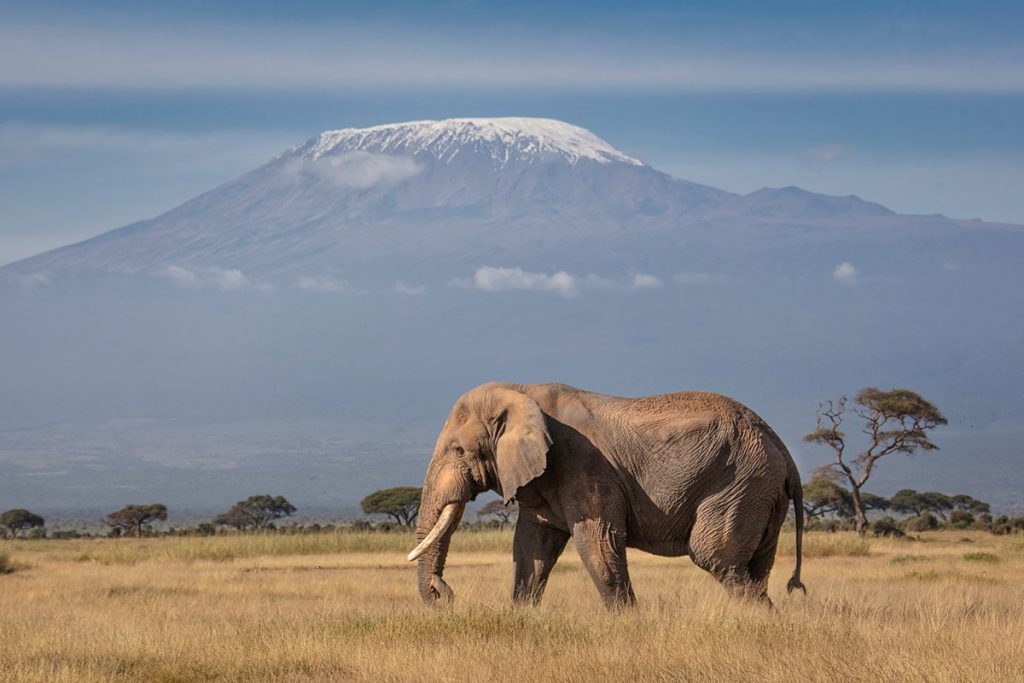
One of the best parks for observing elephants and other large mammals, plus it offers breathtaking views of Africa’s highest mountain, Kilimanjaro. In one visit, you can see several types of natural African savanna habitats – from wetlands to parched plains and forests. As in Masai Mara, you also have the opportunity to visit Maasai ethnic communities.
Best time to visit: June to October

Tsavo West
A mountainous park with picturesque scenery and plenty of animals, including lions, leopards, cheetahs, elephants, buffaloes, hippos, and crocodiles. Visit the famous Mzima Springs, where water gushes from porous volcanic rock only to disappear back into the solidified lava a few kilometers away. It is one of the best places for observing hippos and Nile crocodiles.
Best time to visit: July to September and December to March
Hell’s Gate
One of the small, cheaper parks where you can take a day trip from Nairobi. It directly borders Lake Naivasha and offers stunning rocky scenery. You can explore it on foot or by bike – as there are no large predators living there. During our visit, however, we were glad for the car. We stayed after sunset and on the way back drove right through the middle of a herd of buffalo.
The park also invites you to visit a gorge and canyon, but for me, it was nothing that even remotely approached Adršpach or Bohemian Switzerland. Paradoxically, it was much more interesting to watch giraffes walking past the pipes of the local geothermal power plant.
Best time to visit: June to September

Nairobi
Giraffe Center
Children especially will appreciate this attraction, as you don’t often get this close to giraffes. You can feed them, which is perhaps the most popular activity for visitors. It’s a really strange feeling when a giraffe licks food off your palm with its long tongue, or – if you’re brave enough – it can lick you and “give you a kiss.” If you long for a truly unique experience, book accommodation at the local guest house, where free-roaming giraffes might just stick their heads through your window.

KICC (Kenyatta International Convention Centre)
The more modern part of Nairobi and a place worth visiting (the Maasai Market mentioned later is just a short walk away). You’ll see the statue of Kenya’s first president, and when you get to the top of the tower, you’ll have one of the best views of all of Nairobi. I recommend it especially at night; it’s truly beautiful.

The Maasai Market
Do you know those markets where you can find almost everything and don’t even know what to choose or buy first? That’s exactly what the Maasai Market is. It’s located in the city center and offers everything: jewelry, clothing, ceramic vessels, traditional ornaments. Plus, it’s good quality and at incredibly low prices (which you usually have to haggle for with the local vendors).
I confess that I buy most souvenirs for family and friends there because you can get practically anything and I know it’s not just from some souvenir shop. But expect them to try to push everything on you, often for very high amounts they wouldn’t otherwise sell for. Therefore, I repeat – take a local with you, or at least someone of the same skin color as them; they have a better chance of actually haggling the price down to the original.
Landmarks
Fort Jesus
If you long to discover history, Fort Jesus is definitely for you. Built by the Portuguese in the 16th century as proof that Portugal controlled this part of the world, it still serves as a remnant of colonialism today. You’ll find well-preserved cannons and a stunning view of Mombasa and the Indian Ocean. It is considered one of the most significant monuments in East Africa.

The most beautiful beaches in Kenya
Diani Beach
A popular beach near Mombasa with incredibly white coral sand, palm groves, resorts, and restaurants. Unlike other famous beaches, it manages to maintain a relaxed and relatively quiet atmosphere.
Chale Beach
A beautiful beach on the private island of Chale with a single luxury resort – The Sands At Chale. A perfect place for relaxation, snorkeling, diving, and observing animals in the mangroves. An ideal spot for an exotic honeymoon, for example.

Watamu
A beach town north of Mombasa with white coral beaches, a wide selection of accommodation and restaurants, and especially beautiful coral reefs for unforgettable snorkeling or diving.
Tiwi Beach
Peaceful beaches near Diani, an ideal place for everyone who prefers a relaxed atmosphere and few tourists over comfort and attractions. Of course, you can also snorkel here.
Malindi
Another popular beach town with easy access from Mombasa and Nairobi. As one of the few beaches in Kenya, it offers surfing opportunities even for beginners, with waves breaking right on the beach.

Mount Kenya – hiking to 5,000 meters
For myself – that is, for Matouš – I remember perhaps the most beautiful experience in Kenya being the sunrise from the summit of Africa’s second-highest mountain, Mt. Kenya (5,199 m).
It lies just a few kilometers from the equator, yet right below me was the remainder of a once majestic glacier. As far as the eye could see, a rocky volcanic landscape stretched out. Something completely different from the savannas, tea and coffee plantations, or beaches I originally came to Kenya for.
Compared to the more famous and higher Kilimanjaro, Mt. Kenya has the great advantage of being more of a mountain range rather than a solitary mountain, from which you wouldn’t see much of interest.
If you can manage to hike up the 2000 to 3000 m peaks in the Alps, you can very likely manage the trek to the summit of Mount Kenya. Specifically, one of the 3 main peaks, Point Lenana at a height of 4,985 m. To conquer the two higher peaks, you need climbing equipment and a lot of experience.
Sure, compared to Sněžka, you’ll be a few thousand meters higher, and the chance of getting altitude sickness isn’t exactly small. However, the risk of altitude sickness isn’t that closely related to physical fitness; proper acclimatization is key. In Kenya, you can hike up the 3,000-meter volcano Mt. Longonot near Nairobi as a warm-up, or head to the 4,000-meter Aberdare Range.

The trek to Mt. Kenya is unique partly because you start in “classic” African savanna, but after a while, you enter a beautiful high-altitude rainforest where you wouldn’t be surprised at all if you ran into an Ent from Lord of the Rings. A bit later, you emerge into a landscape reminiscent of the Scottish Highlands. And then you climb through a high-altitude landscape where vegetation gradually disappears and the temperature at night drops well below freezing.

Useful information:
- Distance from Nairobi: 4 hours away, roughly 200 km on a good road
- Distance of the summit from the equator: 20 km
- Length of the trek: 3–7 days
- Park entry: $70 per day
- Best time for the climb: January, February, early March, or August
- Overnight options: Camping in your own tents or mountain huts
- Total cost for the climb: $200 to $1500 USD

You can choose from 3 main routes – the scenic Chogoria, perhaps the most popular Sirimon, and the fastest Naro Moru. Each offers different views and slightly different landscapes. It’s no problem to go up one route and down another. For the Chogoria route, you need your own tent.
To enter Mt. Kenya Park, you need to be at least two people. So you don’t have to go with a guide, although it is highly recommended.

I set off alone, and due to a lack of time and capacity to organize everything, I paid for a complete tour for about $650 USD. It included car transport from Nairobi to the start of the trek, a guide, porters/cook, park entry, food, sleeping in mountain huts, equipment rental (sleeping bag, warm gloves), and car transport back from the end of the trek.

I went up via the Sirimon Route and down via Naro Moru. Originally, the trip was supposed to take 4 days, but I reached the summit early on the morning of the third day and then literally ran down to the Naro Moru gate in about 6 hours. In total, I only needed 3 days of actual time. Generally, though, I don’t have a problem moving at high altitudes and I would definitely leave at least one day as a buffer next time. For the way down, I would also rather choose the Chogoria Route.

Useful links
A practical guide for traveling through Kenya, where you can find not only tips for individual destinations and regions of Kenya but also info regarding visas, traveling around Kenya, and much more.
An ever-improving Wikipedia project where today you can find almost everything you need on your travels.
This guide was prepared to the last detail with a love for Africa by Helena Budilová. Her heart pulls her most to Africa, where she has spent most of her time in Kenya and Rwanda. She mainly focuses on volunteer and public service activities. In addition, she takes photos, creates graphics, writes a blog, and recently co-founded an African safari company, Proud African Safaris, with her African partner. If you are interested in a safari, now you know where to turn. You can reach Helena on Instagram, Facebook, and you can follow her YouTube channel.
It was then updated by Matouš Vinš.